
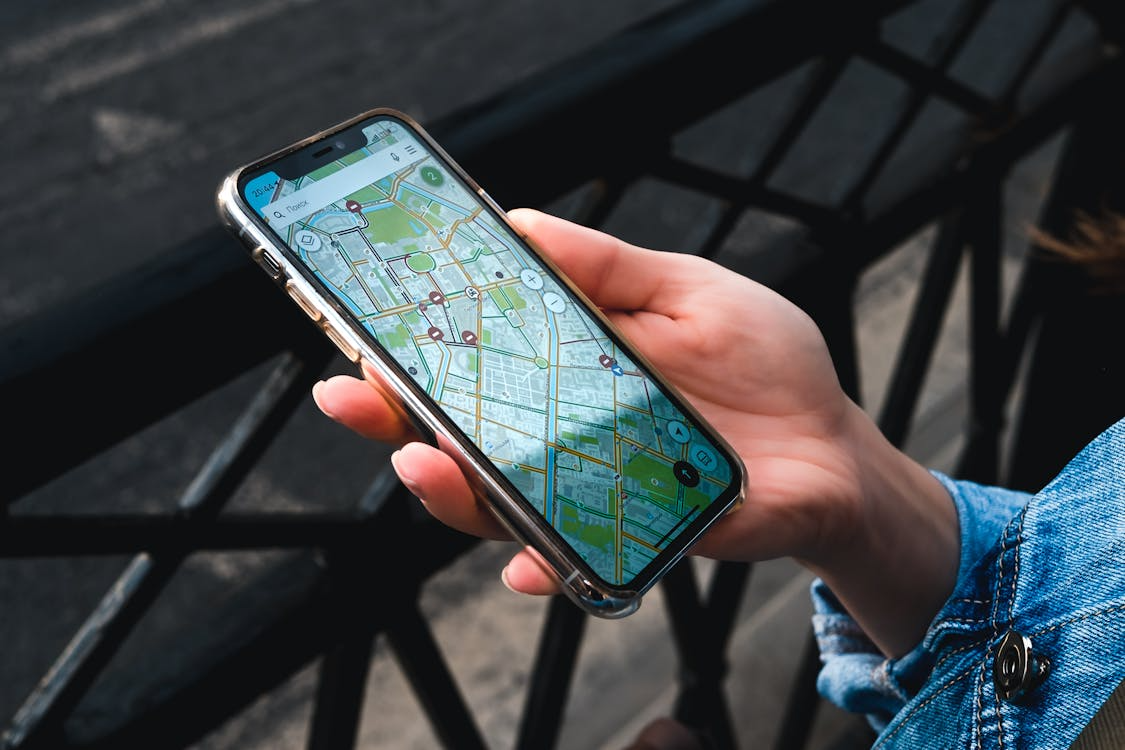
Once you know what’s happening behind the scenes, GPS behavior makes a lot more sense.
It feels almost magical that your phone can pinpoint your location within a few feet, whether you’re driving across town or hiking in unfamiliar terrain. But GPS isn’t magic. It’s geometry, timing, and some clever engineering. Understanding how GPS knows where you can explain its impressive accuracy and the moments when it suddenly fails.
The Role of GPS Satellites
GPS stands for Global Positioning System, and it begins in space. A network of satellites orbits the Earth continuously, each broadcasting a signal that includes its exact position and the precise time the signal was sent.
Your device doesn’t send anything back to these satellites. It only listens. This is important: GPS is a one-way system. The satellites don’t know where you are; your device figures that out on its own.
At any given moment, your phone can usually “see” signals from several satellites overhead. The more satellites it can detect, the more accurate the position calculation becomes.
Explore How The Internet Works (In Plain English) for global network basics.
How Timing Becomes Distance
The key to GPS location is timing. Each satellite signal travels at the speed of light. Your device measures how long it takes for each signal to arrive and converts that time into distance.
If your phone knows it’s 12,000 miles from one satellite, that places you somewhere on a giant sphere around that satellite. Add a second satellite, and your position narrows to where those spheres intersect. A third satellite reduces it further. A fourth helps correct timing errors in your device’s clock.
This process is called trilateration. It’s not guessing; it’s math. The accuracy depends on timing precision, which is why GPS relies on atomic clocks in satellites that are far more accurate than anything in your phone.
Why GPS Needs Multiple Satellites
Technically, three satellites are enough to estimate location, but real-world conditions introduce errors. Buildings, terrain, and atmospheric conditions can delay signals slightly. Using more satellites helps average out these errors.
Your phone is constantly recalculating position as signals update. This is why GPS feels continuous rather than static. Each new calculation refines the last one.
When fewer satellites are available, such as in dense cities or indoors, accuracy drops. The system still works, but with more uncertainty.
Read How Algorithms Decide What You See for pattern-based system logic.
Why GPS Sometimes Fails
GPS signals are weak by the time they reach Earth. They struggle to penetrate buildings, tunnels, dense forests, and underground spaces. This is why GPS often fails indoors or in subway systems.
Urban environments create another problem: signal reflection. Tall buildings can cause signals to bounce, resulting in them arriving slightly later than expected. This confuses distance calculations, leading to drifting or sudden jumps on maps.
Weather doesn’t usually block GPS signals, but atmospheric conditions can subtly affect signal speed. Over long distances, those tiny changes matter.
Check out How Electric Grids Work for another real-time infrastructure system.
How Phones Improve GPS Accuracy
Modern devices don’t rely solely on GPS. They combine satellite data with Wi-Fi networks, cell towers, and motion sensors. This hybrid approach improves accuracy, especially in challenging environments.
Wi-Fi positioning works by comparing nearby networks to known locations. Cell towers provide rough positioning when satellites aren’t available. Motion sensors help smooth movement between fixes.
This is why turning off location services entirely can break apps that rely on more than just GPS. The system works best as a team.
See What The Cloud Means (And Where Your Data Lives) for data storage context.
What GPS Can and Can’t Do
GPS is excellent at determining location, but it doesn’t understand context. It doesn’t know which road you’re on or which floor you’re in. Mapping software adds that layer using stored data and assumptions.
GPS also isn’t instant. It needs time to acquire satellite data, especially after being turned off or moved long distances. That initial delay isn’t failure; it’s setup.
Understanding GPS turns frustration into patience. When it works poorly, it’s usually because physics is in the way, not because the system is broken.